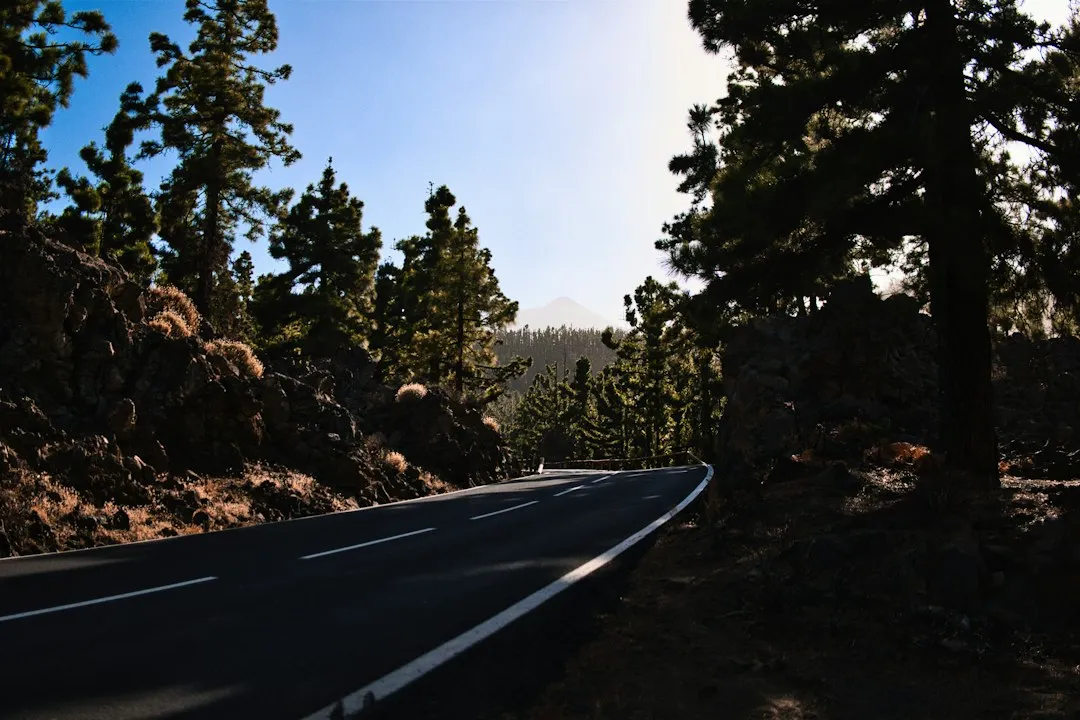
Photo by Tobias Pfeifer on Unsplash
Getting Around Tenerife: Bus, Car, Tram and Ferry
The bus network: TITSA
Public buses on Tenerife are run by TITSA, and locals call them guaguas. The network is dense along the coasts and between the main towns, thinner in the mountains. Key lines from Tenerife Sur airport: the 111 runs along the TF-1 motorway between Santa Cruz and Costa Adeje via the airport (roughly 1 h 30 to the capital, about every 30 minutes); the 343 links Tenerife Sur, Tenerife Norte and Puerto de la Cruz, with the airport-to-airport leg taking about 50 minutes; the 40 connects the airport with Los Cristianos and Costa Adeje; and the 711 is the night service. The 110 is the faster direct service between Santa Cruz and Costa Adeje, but only some departures call at the airport, so check the timetable first.
Fares are calculated by distance. The simplest way to pay is the ten+ card: it costs about €2, you top it up with credit, and you must validate it both when boarding and when getting off; otherwise you are charged the full line fare. The same card, or the ten+ móvil app, also works on the tram. Tourist passes give unlimited travel on buses and tram, currently about €10 for 24 hours and €50 for seven days, sold at airport machines, stations, kiosks and in the app. Single tickets can be bought on board, but the card is simpler and generally cheaper.
Tram and taxis
The Metrotenerife tram has two lines. Line 1 runs between the Intercambiador in Santa Cruz and La Trinidad in La Laguna, 12.5 km with 21 stops, from early morning to midnight on weekdays and around the clock at weekends. Line 2 is a short transverse line between La Cuesta and Tíncer. Taxis are white, metered and plentiful at the airports and in the resorts; Tenerife Sur to Costa Adeje is a short hop, while the airport to Puerto de la Cruz or Santa Cruz is a long and relatively expensive ride.
Car hire
Most visitors who want to see the island hire a car, and it is the only practical way to combine Teide, Masca and Anaga in a short trip. Points worth knowing:
- Manual gearboxes are the default and cheaper; automatics exist, but book early, especially in winter.
- Airport pick-up is straightforward; the cheapest rates often mean a shuttle to an off-site lot.
- Read the insurance terms: basic cover with a high excess is standard, and the "zero excess" option is where the price difference lies. Decide in advance, not at the desk.
- Child seats are legally required for children under 135 cm; reserve them with the car.
- Confirm whether your contract allows taking the car on a ferry to another island; many do not.
Driving on the island
Two motorways carry most traffic: the TF-1 along the south and east coast from Santa Cruz to Adeje and beyond, and the TF-5 from Santa Cruz through La Laguna to Puerto de la Cruz and the north. Both have fixed speed cameras, and the TF-5 is known for rush-hour jams into La Laguna. Mountain roads are well surfaced but narrow and winding: the TF-21 climbs from La Orotava to Teide and down to Vilaflor, the TF-24 follows the ridge from La Esperanza to El Portillo, and the TF-12 crosses Anaga. Give way on roundabouts and never park on hairpins. Parking is tight in Santa Cruz and La Laguna (use the underground car parks) and in central Puerto de la Cruz; at Teide viewpoints and Anaga trailheads the free spaces fill by mid-morning.
Masca: road and gorge
The TF-436 to Masca is a spectacular, tight road of hairpins and single-lane sections; drive it early, before the coaches, and let faster locals pass. Walking the gorge below the village is now regulated: you need a prior reservation on the official site, places are limited, the route is descent-only to the cove with a booked boat out, and a shuttle bus from Santiago del Teide is part of the scheme. Non-residents pay a fee (in the region of €40 per adult in 2026). Days of operation and prices change, so check the official page before planning the day.
Ferries to La Gomera
Fast ferries sail from Los Cristianos to San Sebastián de La Gomera several times a day with more than one operator, taking roughly 50 minutes to an hour. A day trip is feasible; an overnight stay is better. Vehicles can be taken on board, subject to your hire contract.
Cycling and walking
Road cycling is popular with professionals training in winter, but the gradients are serious and motorway hard shoulders are not for bikes. The island has a well-marked trail network, but distances between villages are large and buses to trailheads are infrequent; plan return times carefully.
Bus or car? A quick decision guide
- Resort-based beach holiday with one or two excursions: bus and organised tours are enough.
- Couples or families who want Teide, Masca and Anaga at their own pace: hire a car.
- City break in Santa Cruz and La Laguna: tram and bus, no car needed.
- Walkers heading for remote trailheads: a car, or a taxi for the final leg.
- Nervous drivers: stay on the motorways and use tours for the mountain roads.