Photo by Luis Gonçalves on Unsplash
The Best Beaches in Tenerife: Black Sand, Golden Sand and Natural Pools
Black sand or golden sand
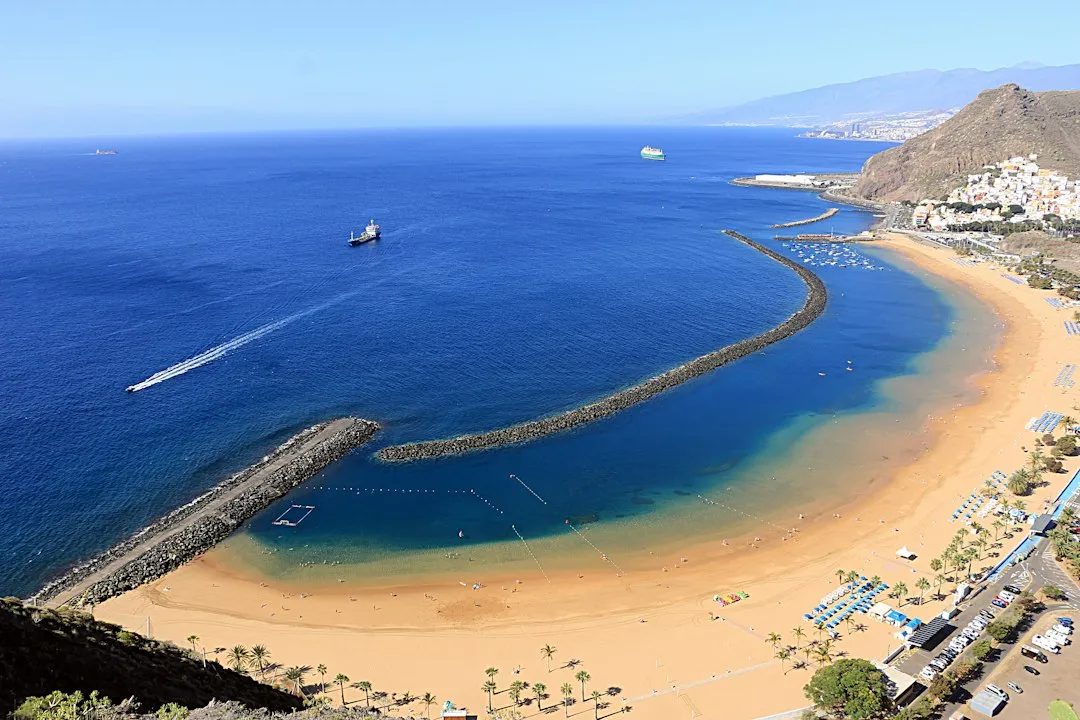
Tenerife is a volcanic island, so its natural beaches are black or dark grey: the sand is basalt and other volcanic rock ground down by the Atlantic. It heats up faster than pale sand in the afternoon. The golden beaches of the south and of Santa Cruz are, in most cases, man-made. The best-known example is Las Teresitas: a cove of pebbles and dark sand was transformed in the early 1970s with sand shipped from the Sahara (the El Aaiún area) and protected by a breakwater, and the new beach opened in 1973. Several resort beaches in Adeje and Arona were also built or enlarged with imported sand and breakwaters.
Which beach for which plan
Las Teresitas (Santa Cruz). A long, golden, palm-lined beach a short drive from the capital, sheltered by a breakwater, so the water is usually calm and shallow. Showers, lifeguards in season, kiosks and a large car park that fills on summer weekends. TITSA's urban line 910 runs from the Santa Cruz interchange to the beach roughly every twenty minutes, which is the easiest way in on busy days.
El Médano and La Tejita (Granadilla). Natural golden sand on the windy south-east coast. El Médano is the island's windsurfing and kitesurfing hub, with a lively small-town seafront; La Tejita, below the Montaña Roja volcanic cone, is a long, undeveloped beach with no buildings on the sand. Expect wind most afternoons. Naturism has long been practised at the northern end of La Tejita.
Playa del Duque, Fañabé, Las Vistas and Los Cristianos (Adeje and Arona). The resort beaches of the south-west: pale sand, breakwaters, sunbeds, lifeguards, promenades and restaurants right behind. Playa del Duque is the most polished; Fañabé and Las Vistas are family favourites; Los Cristianos sits next to the ferry port. Playa del Duque, Torviscas and Las Vistas hold the Blue Flag in 2026, while Los Cristianos lost its flag this year.
Playa Jardín (Puerto de la Cruz). The north's urban beach: black sand in three bays, framed by gardens designed by César Manrique in the 1990s and protected by breakwaters. Full services and a strong Atlantic feel; check the flag before swimming.
Benijo and Almáciga (Anaga). Wild black-sand coves below the Anaga cliffs, with the Roques de Anaga offshore. Spectacular, especially at low tide and sunset, but exposed to strong surf and currents, with no lifeguards. Note that Benijo itself has been officially closed since July 2024 because of rockfalls on its access stairs, and stabilisation works were still pending in autumn 2026. Almáciga, next door, remains the practical choice.
Playa de la Arena and Los Gigantes (Santiago del Teide). Black sand on the west coast beneath the Los Gigantes cliffs, which rise several hundred metres straight out of the sea. Playa de la Arena has full services and some of the island's best sunsets; the cliffs are best seen from the water on a boat trip.
Natural pools. Where there is no sand, the north coast offers lava pools filled by the ocean: Bajamar and Punta del Hidalgo near La Laguna (the Bajamar pools fly a Blue Flag in 2026) and El Caletón in Garachico, below the old town. They are closed or dangerous in heavy swell, so follow the signs.
Safety on Tenerife beaches
Supervised beaches use the Spanish flag system: green means swimming is allowed, yellow calls for caution, red means no swimming. Lifeguard coverage is seasonal and varies by municipality; many urban beaches are staffed through the summer and on weekends, but Anaga and other wild coves have no service at all. The north and the Anaga coast face the open Atlantic: rip currents and sudden sets of waves catch out swimmers every year, so stay close to shore and never turn your back on the sea when standing on rocks. The sun is strong all year and black sand radiates heat; bring shade, water and high-factor sunscreen.
Practical notes
- Parking: urban and resort beaches have car parks or street parking that fill by late morning in summer. At Las Teresitas the 910 bus avoids the queue; for Anaga, TITSA line 946 reaches Taganana and Almáciga from Santa Cruz, with reduced winter frequencies.
- Naturism: no Spanish law restricts nudity to specific beaches. The northern end of La Tejita and the Anaga coves are the traditional naturist spots; resort beaches are not.
- Facilities: the south-west resort beaches and Las Teresitas have showers, toilets and sunbed hire. Wild beaches have nothing, so bring what you need and take your rubbish back.
- The sea stays swimmable all year, roughly 19 °C in late winter and 24 °C in early autumn.